
General introduction of stars
A star is a luminous massive ball of plasma held together by gravity. The Sun is the nearest star to Earth, and it is the source of life and energy essential for our survival.Other stars are visible from Earth during the night when the Sun does not outshine them and the atmospheric phenomena does not block them. .
A star begins as a collapsing cloud of material composed primarily of hydrogen, along with helium and trace amounts of heavier elements. Once the stellar core is sufficiently dense, some of the hydrogen is steadily converted into helium through the process of nuclear fusion. The remainder of the star's interior carries energy away from the core through a combination of reactive and convective processes. The star's internal pressure prevents it from collapsing further under its own gravity. The star then evolves into a degenerate form, recycling a portion of the matter into the interstellar environment, where it will form a new generation of stars with a higher proportion of heavy elements.
Age of stars
Most stars are between 1 billion and 10 billion years old. Some stars may even be close to 13.7 billion years old, which is the observed age of the universe. The oldest star yet discovered, HE 1523-0901, is an estimated 13.2 billion years old.
The more massive the star, the shorter its lifespan is. This is primarily because massive stars have greater pressure on their cores, causing them to burn hydrogen more rapidly. The most massive stars last an average of about one million years, while stars of minimum mass burn their fuel very slowly and last tens to hundreds of billions of years.
Types of stars
Protostar
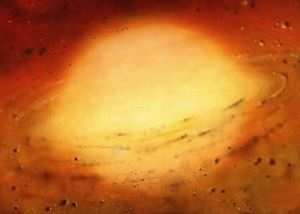 |
| Fig 5.1 Protostar |
A protostar is a collection of gas that has collapsed down from a giant molecular cloud. The protostar phase of stellar evolution lasts about 100,000 years. Over time, gravity and pressure increase, forcing the protostar to collapse down. All of the energy release by the protostar comes only from the heating caused by the gravitational energy.
T Tauri Star
A T Tauri star is the stage in a star’s formation and evolution right before it becomes a main sequence star. This phase occurs at the end of the protostar phase, when the gravitational pressure holding the star together is the source of all its energy. T Tauri stars do not have enough pressure and temperature at their cores to generate nuclear fusion, but they do resemble main sequence stars. T Tauri stars can have large areas of sunspot coverage, and have intense X-ray flares and extremely powerful stellar winds. Stars will remain in the T Tauri stage for about 100 million years.
Main Sequence Star
The majority of all stars in our galaxy are main sequence stars. Our Sun is a main sequence star, and so are our nearest neighbors, Sirius and Alpha Centauri A. Main sequence stars can vary in size, mass and brightness, but they are all converting hydrogen into helium in their cores, releasing a tremendous amount of energy.
A star in the main sequence is in a state of hydrostatic equilibrium. Gravity is pulling the star inward, and the light pressure from all the fusion reactions in the star are pushing outward. The inward and outward forces balance one another out, and the star maintains a spherical shape. Stars in the main sequence will have a size that depends on their mass, which defines the amount of gravity pulling them inward.
The lower mass limit for a main sequence star is about 0.08 times the mass of the Sun, or 80 times the mass of Jupiter. This is the minimum amount of gravitational pressure you need to ignite fusion in the core. Stars can theoretically grow to more than 100 times the mass of the Sun.
Red Giant Star
When a star has consumed its stock of hydrogen in its core, fusion stops and the star no longer generates an outward pressure to counteract the inward pressure pulling it together. A shell of hydrogen around the core ignites continuing the life of the star, but causes it to increase in size dramatically. The aging star has become a red giant star, and can be 100 times larger than it was in its main sequence phase. When this hydrogen fuel is used up, further shells of helium and even heavier elements can be consumed in fusion reactions. The red giant phase of a star’s life will only last a few hundred million years before it runs out of fuel completely and becomes a white dwarf.
White Dwarf Star
When a star has completely run out of hydrogen fuel in its core and it lacks the mass to force higher elements into fusion reaction, it becomes a white dwarf star. The outward light pressure from the fusion reaction stops and the star collapses inward under its own gravity. A white dwarf shines because it was a hot star once, but there is no fusion reactions happening any more. A white dwarf will just cool down until it because the background temperature of the Universe. This process will take hundreds of billions of years, so no white dwarfs have actually cooled down that far yet.
Red Dwarf Star
 |
| Fig 5.2 Red Dwarf Star |
Red dwarf stars are the most common kind of stars in the Universe. These are main sequence stars but they have such low mass that they are much cooler than stars like our Sun. Red dwarf stars are able to keep the hydrogen fuel mixing into their core, and so they can conserve their fuel for much longer than other stars. Astronomers estimate that some red dwarf stars will burn for up to 10 trillion years. The smallest red dwarfs are 0.075 times the mass of the Sun, and they can have a mass of up to half of the Sun.
Neutron Stars
If a star has between 1.35 and 2.1 times the mass of the Sun, it does not form a white dwarf when it dies. Instead, the star dies in a catastrophic supernova explosion, and the remaining core becomes a neutron star. A neutron star is an exotic type of star that is composed entirely of neutrons. This is because the intense gravity of the neutron star crushes protons and electrons together to form neutrons. If stars are even more massive, they will become black holes instead of neutron stars after the supernova goes off.
Supergiant Stars
The largest stars in the Universe are supergiant stars. These are monsters with dozens of times the mass of the Sun. Unlike a relatively stable star like the Sun, supergiant stars are consuming hydrogen fuel at an enormous rate and will consume all the fuel in their cores within just a few million years. Supergiant stars live fast and die young, detonating as supernovae; completely disintegrating themselves in the process.

